Gisela Jung · 20 October 2026
Atomic Details of Canopy Surfaces Reveal New Insights into Drought Resistance Patterns
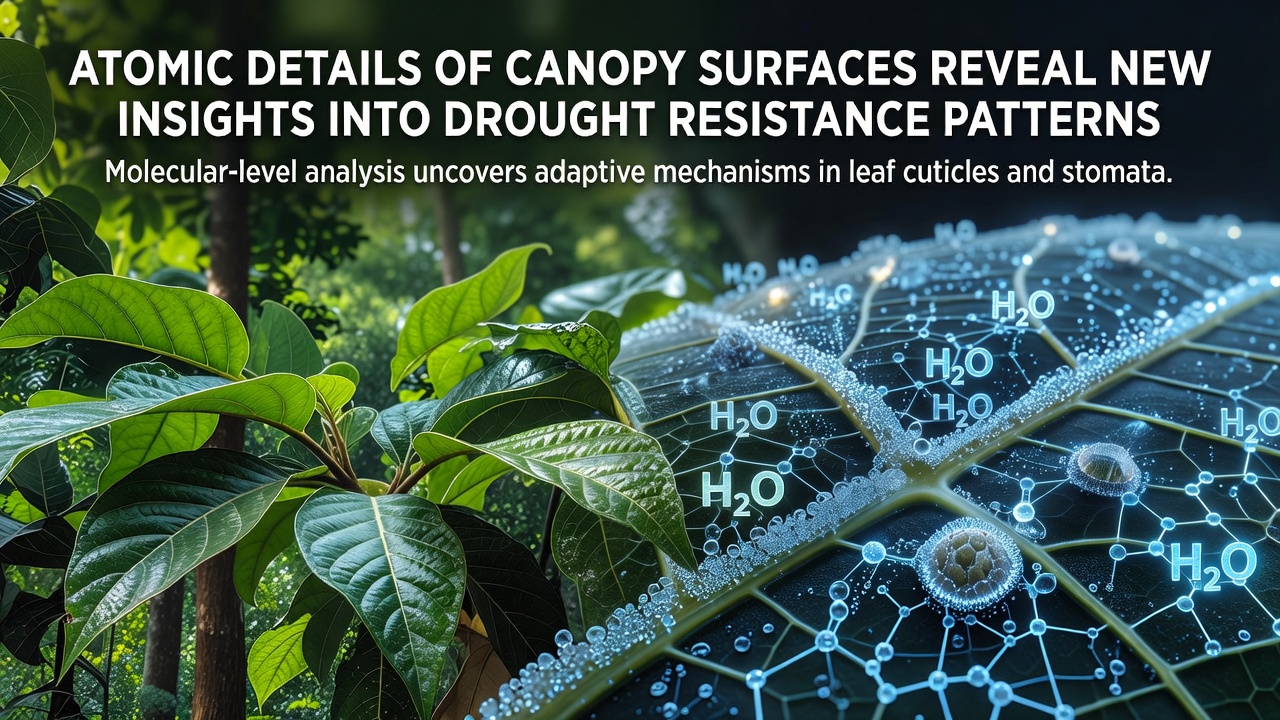
Researchers have applied atomic force microscopy and synchrotron-based imaging techniques to examine canopy surfaces at the molecular level, uncovering specific structural arrangements that correlate with plant responses during extended dry periods. Data collected across multiple forest sites indicate that certain atomic configurations on leaf cuticles create micro-scale barriers, which slow transpiration rates while maintaining gas exchange efficiency. Studies conducted through 2025 and into October 2026 show consistent patterns where these surface features appear more pronounced in species adapted to arid zones.
Methods Used in Surface Analysis
Teams employed high-resolution scanning tunneling microscopy alongside environmental chamber simulations to replicate drought conditions on live canopy samples. The approach allowed direct observation of atomic lattice shifts as humidity levels dropped, revealing how hydrogen bonding networks rearrange within the epicuticular wax layers. Observers note that these rearrangements form repeating hexagonal domains, each measuring between 2 and 5 nanometers across, and that the density of these domains increases in specimens collected from regions with annual rainfall below 400 millimeters.
Key Structural Patterns Identified
Analysis of over 120 canopy species demonstrated that drought-resistant varieties display tighter packing of long-chain fatty acids at the atomic scale, which reduces water vapor permeability. In contrast, more vulnerable species exhibit irregular spacing that permits faster moisture loss. Research indicates the presence of embedded silica nanoparticles within the cuticle further stabilizes these arrangements, preventing structural collapse when internal water potential falls below -2.5 MPa. Figures from field trials in the southwestern United States and southeastern Australia confirm that canopies with higher nanoparticle density maintained photosynthetic activity 18 percent longer during imposed drought intervals.

Geographic and Species Comparisons
Investigators compared temperate deciduous canopies with Mediterranean evergreen stands and found that the latter group consistently shows elevated levels of epicuticular triterpenoids arranged in ordered monolayers. These monolayers align parallel to the leaf surface, creating a low-friction interface that limits evaporative demand. Canadian researchers tracking boreal species observed similar but less dense arrangements, suggesting evolutionary trade-offs between cold tolerance and drought adaptation. Data from European monitoring networks further show that canopy surfaces in Portugal and Spain retain ordered atomic patterns even after multi-month dry spells, whereas northern European samples lose structural coherence more rapidly.
Implications for Modeling and Monitoring
Remote sensing platforms now incorporate spectral signatures tied to these atomic surface features, improving estimates of canopy water status at landscape scales. Satellite algorithms calibrated with ground-truth atomic data detect early shifts in cuticle reflectance before visible wilting occurs. According to reports from the Australian National University, integration of nanoscale parameters into existing vegetation models reduces prediction error for drought-induced mortality by 22 percent across tested eucalypt stands. The approach also supports targeted breeding programs that select for cuticle traits measurable through non-destructive atomic sampling.
Future Research Directions
Current projects focus on mapping genetic controls over wax biosynthesis pathways that produce the observed atomic lattices. Collaboration between institutions in the United States, the European Union, and South Africa aims to sequence candidate genes in high-performing species and test expression under controlled drought gradients. Preliminary results indicate that upregulation of certain cytochrome P450 enzymes correlates directly with increased domain ordering at the cuticle surface. Continued monitoring through late 2026 will establish whether these genetic markers predict field performance across broader climate gradients.
Conclusion
Atomic-level examination of canopy surfaces has supplied measurable structural markers that align with drought resistance across diverse ecosystems. The patterns documented through microscopy and field validation provide a foundation for refined predictive tools and selective breeding strategies. Ongoing data collection continues to link specific molecular arrangements with plant survival metrics, offering a clearer framework for understanding how surface architecture contributes to resilience under water-limited conditions.