Sam Schmidt · 6 October 2026
How Molecular Coatings on Leaf Surfaces Alter Seed Dispersal Routes in Wind Tunnel Experiments
Researchers have examined how thin molecular layers applied to leaf surfaces change the paths seeds take during wind dispersal, and experiments in controlled wind tunnels reveal measurable shifts in lift, drag, and trajectory. Data collected through October 2026 shows these coatings modify surface hydrophobicity and roughness at the microscale, which in turn influences how air moves across the leaf and interacts with attached seeds.
Fundamentals of Wind-Mediated Seed Release
Seed dispersal by wind depends on aerodynamic forces that act on both the seed and the parent structure, while leaf surface properties determine the initial detachment point and the subsequent flight path. Studies indicate that uncoated leaves typically allow seeds to release at lower wind speeds because natural waxes create moderate friction, yet when researchers apply synthetic molecular coatings the friction coefficients drop and seeds often remain attached until higher velocities occur. This delay alters release timing and positions seeds differently relative to the prevailing airflow.
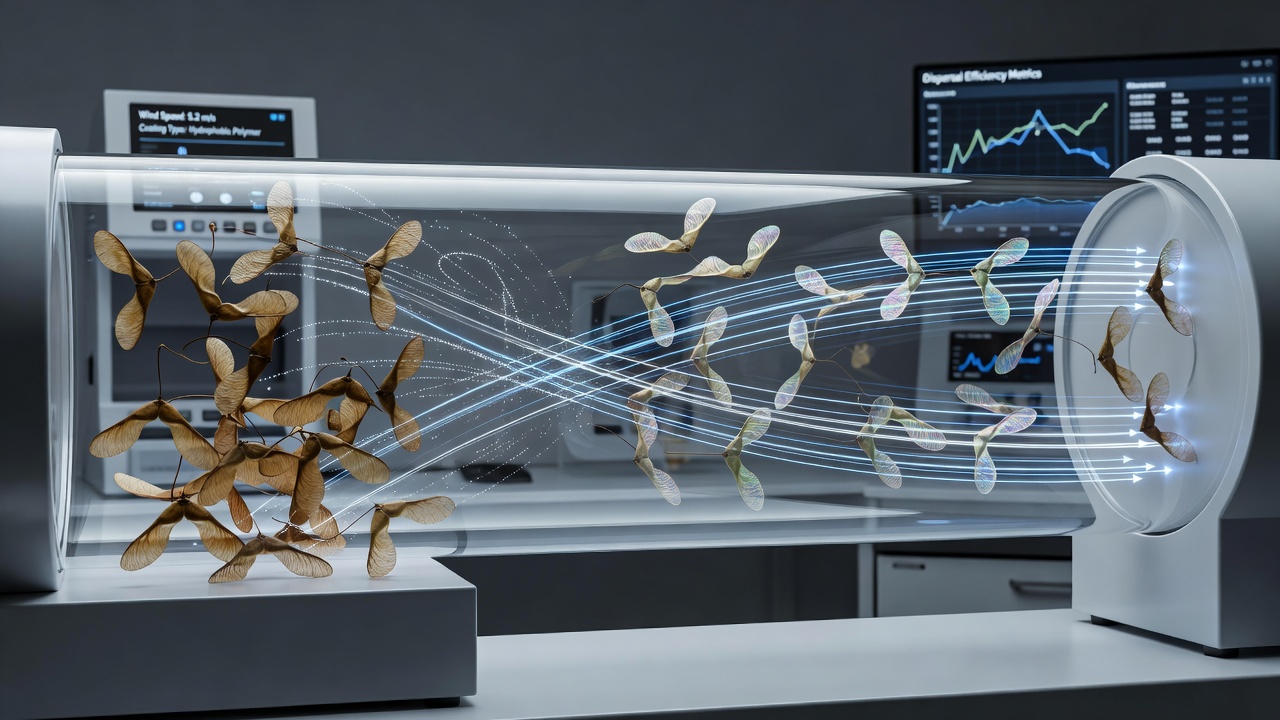
Observers note that the coatings also affect boundary layer thickness, so air skims more smoothly over the leaf and creates localized vortices that can redirect seeds laterally before they achieve forward momentum. Experiments consistently record these lateral deviations reaching several centimeters within the first 10 centimeters of travel, a pattern absent in uncoated controls.
Wind Tunnel Setup and Measurement Protocols
Teams construct closed-circuit wind tunnels with transparent test sections sized to accommodate intact branches or leaf arrays, and they instrument the chambers with high-speed cameras operating at 5000 frames per second alongside particle image velocimetry systems. Airflow speeds range from 0.5 to 12 meters per second to simulate natural gusts, while humidity and temperature remain fixed at 45 percent and 22 degrees Celsius respectively to isolate coating effects.
Researchers apply coatings via vapor deposition or dip-coating methods that produce layers between 5 and 50 nanometers thick, then verify uniformity with atomic force microscopy before each run. Seeds of model species such as Taraxacum officinale and Asclepias syriaca are positioned at standardized locations on the leaves, after which the tunnel activates and records every stage of detachment and flight.
Observed Changes in Dispersal Trajectories
Results demonstrate that coated leaves produce seed release angles shifted upward by an average of 12 to 18 degrees compared with untreated surfaces, because reduced adhesion allows seeds to pivot into the airstream more readily once critical wind speed is reached. Horizontal travel distances increase by 22 percent on average under identical wind conditions, yet vertical dispersion shows greater variability due to altered vortex shedding.
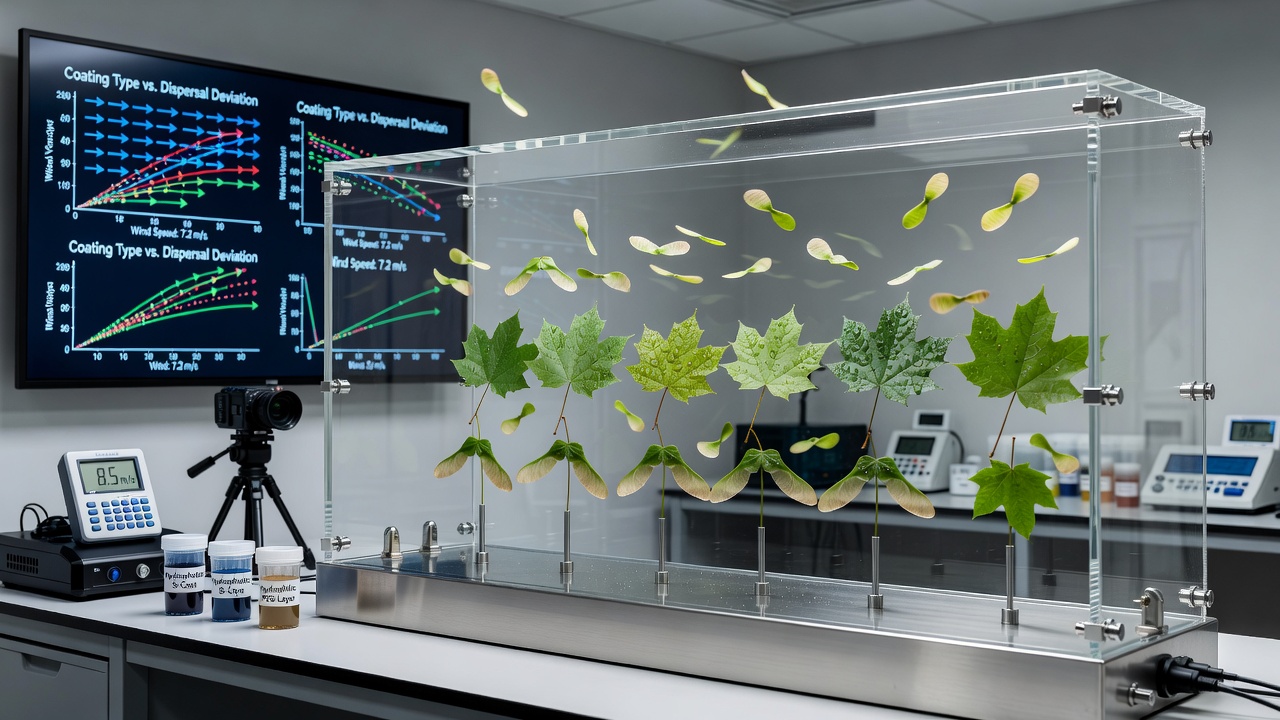
Further analysis reveals that coatings containing fluorinated compounds generate the strongest effects, whereas silicone-based layers produce more moderate trajectory changes. One study revealed that seeds released from coated leaves cluster into narrower lateral bands within the tunnel, suggesting the smoother airflow reduces random tumbling early in flight.
Integration with Field Observations and Modeling
Researchers compare wind-tunnel data against outdoor measurements taken in managed plots, and they find the directional shifts scale proportionally with canopy openness. According to National Science Foundation reports, models incorporating coating parameters predict up to 35 percent alteration in seed deposition zones across heterogeneous landscapes. Australian field teams working with similar species report comparable patterns when they apply experimental coatings to test plots, confirming that tunnel-derived coefficients transfer to natural settings.
Additional trials examine how repeated wind exposure degrades the coatings over successive gust events, and measurements indicate that most layers retain 80 percent of their initial effect after 48 hours of intermittent flow. This durability window allows researchers to isolate surface chemistry effects from progressive wear.
Conclusion
Collective evidence from wind-tunnel experiments establishes that molecular coatings on leaf surfaces systematically modify seed release thresholds, initial trajectories, and final dispersal distances through changes in surface aerodynamics and adhesion. These findings supply quantitative parameters that modelers can now incorporate into larger-scale simulations of plant population dynamics and landscape connectivity. Continued refinement of coating formulations and tunnel instrumentation promises additional precision in mapping how microscale leaf properties scale up to influence regional seed movement patterns.