Cameron Berger · 22 September 2026
Mapping Submicroscopic Foliage Textures to Refine Acoustic Monitoring of Urban Biodiversity Shifts
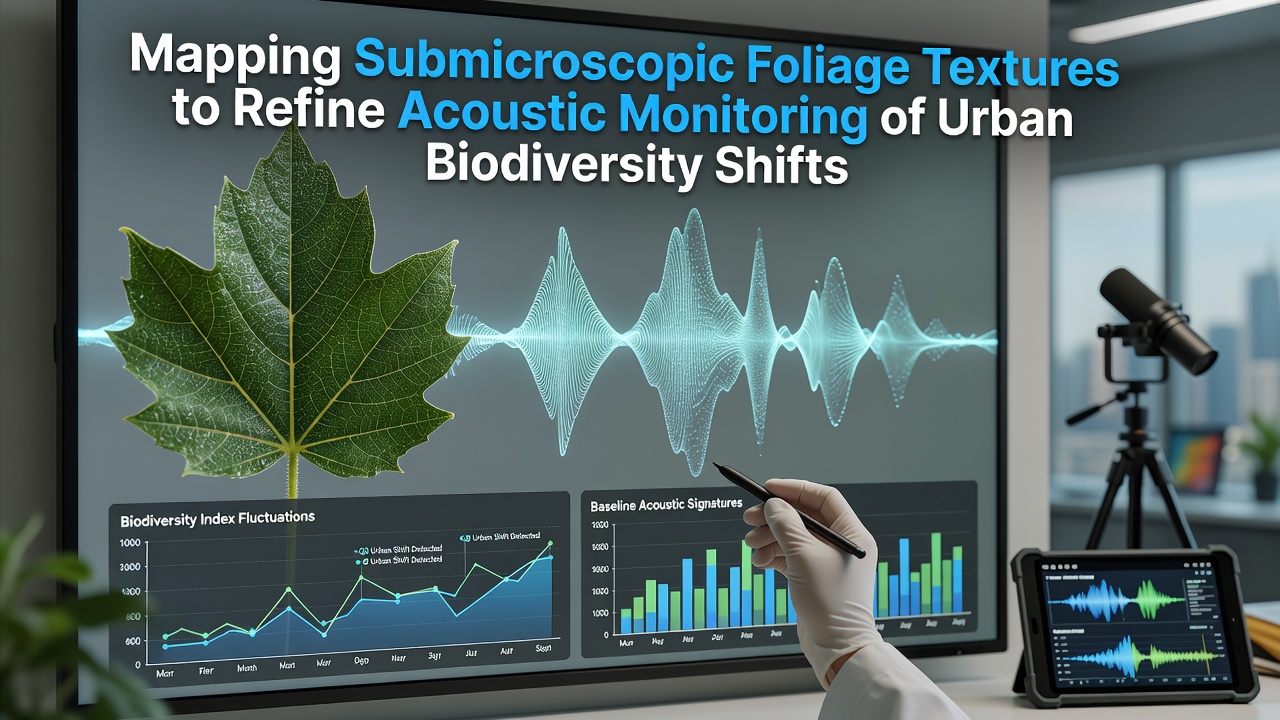
Researchers in urban ecology have turned attention toward the fine-scale surface features of leaves and branches because those textures interact directly with sound waves in city environments, and mapping them at submicroscopic resolution allows acoustic sensors to distinguish animal vocalizations from background noise more precisely. Data collected across multiple metropolitan areas show that foliage microstructure influences how ultrasonic and audible frequencies scatter, which in turn affects the accuracy of biodiversity inventories derived from passive acoustic monitoring arrays. Studies conducted in dense residential zones indicate that variations in epicuticular wax crystals and stomatal patterns alter reverberation times by measurable amounts, providing quantifiable parameters that improve species detection algorithms.
Submicroscopic Features and Sound Propagation
Leaf surfaces at scales below one micrometer contain ridges, pores, and crystalline deposits that create micro-reflections when sound passes through or bounces off vegetation layers, and these interactions become especially pronounced in the 20 to 200 kilohertz range commonly used for bat and insect surveys. High-resolution atomic force microscopy combined with scanning electron imaging reveals consistent differences between species common in parks versus those along roadside medians, differences that correlate with observed shifts in recorded call clarity. When researchers incorporate these texture maps into acoustic propagation models, false positive rates for certain bird and amphibian calls drop because the software can now account for localized absorption and scattering coefficients that standard canopy density metrics overlook.
Urban Biodiversity Monitoring Challenges
Cities present layered soundscapes where traffic, construction, and mechanical systems overlap with biological signals, yet traditional acoustic indices often aggregate data without adjusting for vegetation-specific filtering effects. Long-term deployments in European and North American cities demonstrate that seasonal changes in foliage texture coincide with measurable alterations in detected species richness, particularly during leaf-out and senescence periods. Mapping programs initiated in 2024 and expanded through 2025 have produced three-dimensional texture libraries that feed directly into real-time processing pipelines, allowing analysts to normalize recordings against site-specific foliage conditions rather than relying on generalized vegetation indices.
Techniques for Texture Mapping and Integration
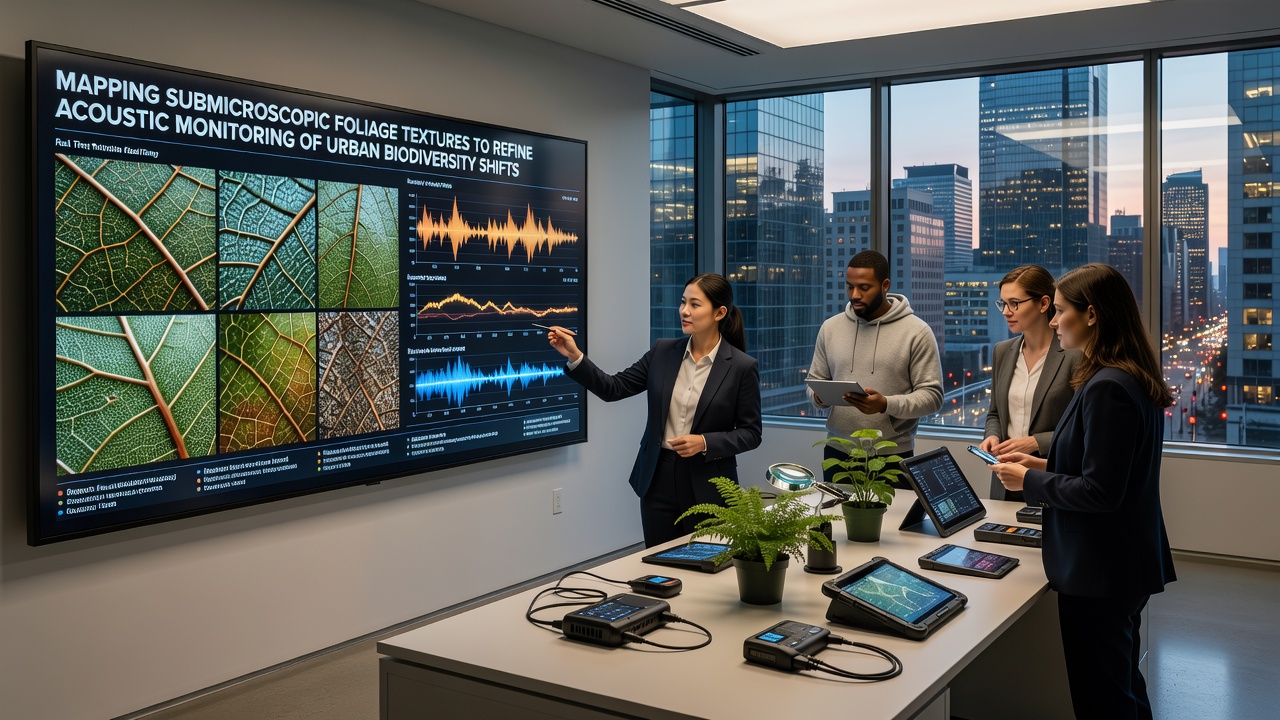
Teams combine hyperspectral drone imagery with ground-based confocal microscopy to generate layered texture models that align spatial coordinates of individual plants with their acoustic properties, and the resulting datasets undergo machine-learning classification to predict how each texture class modifies incoming sound. Field trials completed in mid-2025 showed that models trained on submicroscopic maps achieved higher precision in identifying cryptic species whose calls occupy narrow frequency bands easily masked by foliage reflections. Integration occurs through open-source acoustic analysis platforms that accept texture parameters as additional input variables, enabling automated correction of sound attenuation estimates across heterogeneous urban green spaces.
September 2026 marks the scheduled release of an updated global urban acoustics database coordinated by multiple research institutions, and early previews indicate that texture-mapped correction factors will form a core component of the new release. Observers note that cities participating in pilot programs already report improved tracking of biodiversity shifts linked to heat-island mitigation projects and green-infrastructure expansions. Calibration routines now include periodic texture resampling because dust accumulation and pollution deposition alter surface properties over weeks to months, requiring dynamic updates to maintain model accuracy.
Applications in Policy and Research
Municipal planning departments have begun requesting texture-enhanced acoustic reports when evaluating development impacts on local wildlife corridors, and the approach supports compliance with emerging biodiversity net-gain regulations in several jurisdictions. Research groups at institutions focused on environmental sensing have published protocols that standardize texture sampling methods across temperate and subtropical zones, reducing inter-site variability in comparative studies. Data from these standardized surveys feed into larger syntheses that examine how urban vegetation management influences long-term species composition trends, particularly for pollinators and nocturnal vertebrates whose activity patterns are captured reliably through acoustic methods.
Conclusion
Continued refinement of submicroscopic foliage texture maps supports more reliable acoustic monitoring networks that document urban biodiversity shifts with greater spatial and temporal resolution. As mapping coverage expands and sensor networks scale, the combined datasets provide objective baselines against which future changes can be measured, and the methods remain adaptable to new urban plantings and restoration initiatives worldwide.